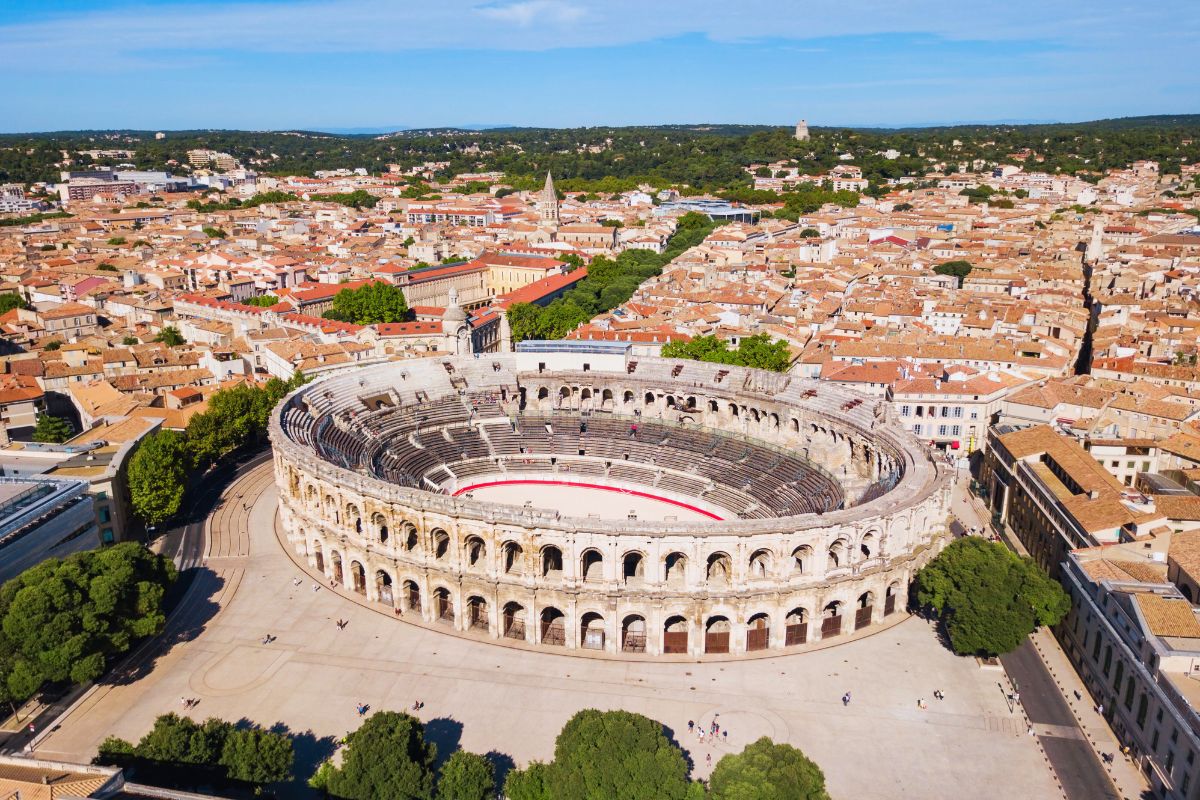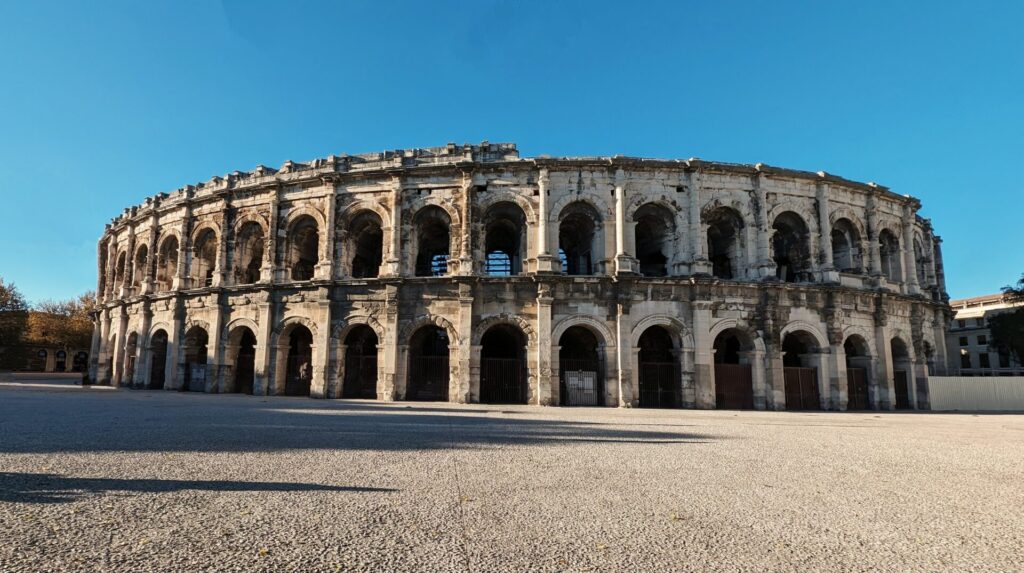
Imagine strolling beneath the majestic arcades of a 2,000-year-old monument, a silent witness to gladiator fights and the grand spectacles of Roman times. The Arènes de Nîmes, a true architectural gem, stand in the heart of the Gard city with unrivalled presence. One of the best-preserved Roman amphitheatres in the world, this stone colossus continues to amaze more than 350,000 visitors every year. Its fascinating history and remarkable state of preservation make it an essential part of France’s ancient heritage.
In this article, we invite you on a journey through time to discover all the secrets of the Arènes de Nîmes. From its construction under the Roman Empire to its transformation into a medieval fortress and then a modern arena, its history will surprise you. We will guide you through its corridors and tiers, reveal the unmissable events held there and explain why this monument has come through the centuries so gracefully. Discover the Arènes de Nîmes: the history, visits and unmissable events that make this monument a pillar of tourism in Nîmes and a living symbol of the Roman legacy in France.
Take a virtual tour of the Roman arena of Nîmes
To round off our exploration of the Arènes de Nîmes, we invite you to watch this magnificent video entitled “Les arènes de Nîmes – Région Languedoc Roussillon – Le Monument Préféré des Français”. This film captures the full majesty of the amphitheatre and offers striking views of this Roman architectural gem. The aerial footage reveals how perfectly the monument sits within the urban fabric of Nîmes, while the interior shots let you appreciate the technical prowess of the ancient builders. This video, found online to illustrate our article, is not the property of this blog. It is nonetheless an ideal complement to our written presentation, immersing you in the unique atmosphere of the arena before your visit.
History and origins of the Arènes de Nîmes
In the heart of ancient Roman Gaul, the Arènes de Nîmes are one of the most impressive testimonies to the Roman presence in France. Built around AD 70-80 during the reign of Emperor Augustus, they were part of the vast urban development programme of the colony of Nemausus, founded for veterans of the Egyptian campaign.
From Roman amphitheatre to medieval fortress
Building this architectural colossus took almost twenty years of titanic work. Designed to hold up to 24,000 spectators, the amphitheatre was originally dedicated to gladiator fights and wild animal hunts, entertainments much loved by the Romans.
With the fall of the Roman Empire in the 5th century, the monument underwent a radical transformation. The arena was converted into a genuine urban fortress, home to nearly 700 inhabitants and forming a fortified village with its houses, two chapels and even a small public square. This medieval occupation, although damaging to some structures, paradoxically contributed to the monument’s preservation.
The rebirth of an ancient gem
It was not until the 18th century that interest in this exceptional heritage revived. In 1786, a first restoration campaign was launched, marking the start of a long reclamation of the monument. But it was really in the 19th century, under the impetus of the architect Henri Révoil, that the arena regained its former splendour.
In 1863, Napoleon III ordered the building to be cleared completely, freeing the arena from the makeshift structures that cluttered it. This rebirth allowed the monument to recover its role as a venue for shows, adapted to modern uses. The first corridas were held there as early as 1853, ushering in a new era for this exceptional relic of Roman Antiquity.
Roman architecture and conservation of the monument
The remarkable architecture of the Arènes de Nîmes bears witness to Roman genius in monumental construction. Built at the end of the 1st century AD, the arena is one of the most accomplished examples of ancient engineering. Its elliptical structure measures 133 metres long by 101 metres wide and could hold up to 24,000 spectators, seated according to their social rank.
A feat of Roman architecture
The outer façade consists of two superimposed levels of arcades, each with 60 arches. This double row of arcades rests on massive pillars and features a system of vaults in local limestone. The technical innovation of the Roman builders is particularly evident in the internal circulation system: 124 vomitoria (passageways) allowed spectators to reach their seats quickly.
The seating (cavea) was divided into four distinct zones: the ima cavea for the nobles, the media cavea for the knights, the summa cavea for the plebeians and, at the very top, a covered portico reserved for women and slaves. This spatial hierarchy perfectly reflected Roman social organisation.
Exceptional preservation through the centuries
Unlike many ancient monuments, the Arènes de Nîmes have survived the ravages of time remarkably well. In the Middle Ages they were turned into a fortress, home to nearly 700 inhabitants. This reuse, although it partly altered the building, paradoxically helped preserve it by giving it a practical function.
The first significant restorations began in the 19th century, at the instigation of Victor Hugo and Prosper Mérimée. In 1863, the architect Henri Révoil undertook major works that gave the arena back its original appearance. Since then, conservation efforts have never stopped, with increasingly sophisticated techniques to combat erosion and damage of all kinds.
Now a UNESCO World Heritage Site, the amphitheatre is permanently monitored and regularly restored, ensuring its survival for future generations.
Visiting the Arènes de Nîmes: opening times, prices and access
Having explored the history and admired the remarkable architecture of the Arènes de Nîmes, it is time to give you all the practical information you need to plan your visit to this gem of Roman heritage. Preparing your trip carefully will let you make the most of this iconic monument.
Seasonal opening times
The Arènes de Nîmes welcome visitors all year round, with opening times that vary by season. From March to October, you can visit the amphitheatre from 9am to 7pm, with later closing at 8pm in July and August so you can enjoy the mild summer evenings. In the low season (November to February), hours are reduced to 9.30am to 5pm. Note that the monument is closed on certain public holidays such as 1 January and 25 December.
To avoid the crowds, visit in the morning as soon as it opens or in the late afternoon, especially during the peak tourist season from June to September.
Prices and ticket options
Full-price admission to the arena is €10 per adult. Discounts are available for students, seniors and groups (€8). Entry is free for children under 7 and reduced (€4) for 7-17-year-olds. Roman history enthusiasts should opt for the Pass Monuments, which gives access to three major sites (the arena, the Maison Carrée and the Tour Magne) for €13, a very good-value option.
Booking online on the official Nîmes monuments website saves you time by avoiding the queues, which is particularly useful at busy times.
How to get to the arena
Located right in the heart of Nîmes, the arena is easy to reach. It is a 10-minute walk from the SNCF railway station. For those arriving by car, there are several paying car parks nearby, including the arena car park directly beneath the esplanade. Nîmes public transport also serves the site, with several bus stops close by.
People with reduced mobility can access the amphitheatre thanks to specific facilities, although some parts of the monument remain difficult to reach because of its historic layout.
What events are held at the Arènes de Nîmes
As living witnesses to Antiquity, the Arènes de Nîmes still pulse today to the rhythm of a rich and varied cultural programme. This 2,000-year-old monument is not frozen in the past – every year it hosts events that attract visitors from all over the world, thus continuing its original role as a venue for shows.

The Féria de Nîmes and the corridas
The highlight of the Nîmes year, the Féria de Nîmes turns the city and its amphitheatre into the epicentre of French bullfighting culture. The celebration takes place twice a year: the Pentecost Feria in May-June and the Feria des Vendanges in September. The arena then becomes the stage for prestigious corridas featuring the greatest international matadors.
During these events, the amphitheatre returns to its original purpose of hosting shows in which courage and tradition come together in a unique atmosphere. The passion for bullfighting is given full expression in this exceptional historic setting, which lends the bullfights a special dimension.
The Grands Jeux Romains
Every spring, the Grands Jeux Romains (Great Roman Games) offer a spectacular plunge into Antiquity. These meticulous historical re-enactments bring gladiator fights, chariot races and Roman religious ceremonies back to life. More than 500 re-enactors from all over Europe take part in this event, which draws thousands of spectators.
Concerts and contemporary shows
The remarkable acoustics and grandiose setting of the arena make it a stage sought after by the greatest international artists. The programme of the Festival de Nîmes, held every summer, offers exceptional musical diversity, from rock to pop by way of electro and classical music.
David Bowie, Rammstein, Radiohead, Elton John and Céline Dion have all performed there, creating magical moments in which the beauty of the venue enhances the musical experience. Other events such as operas, dance shows and monumental projections round off this unique cultural offering, making the arena a place of intense and varied cultural life.
Why are the Arènes de Nîmes so well preserved
The remarkable preservation of the Arènes de Nîmes over the centuries is no accident. Several factors explain why this ancient monument has come down to us in such exceptional condition, unlike other Roman amphitheatres that have suffered far more damage over time.
A conversion that saved the monument
Paradoxically, it was the transformation of the arena into a fortress in the Middle Ages that helped preserve it. In the 6th century, the amphitheatre was converted into a fortified quarter housing more than 700 inhabitants and two churches. This functional reuse protected the original structure from the systematic dismantling suffered by other Roman monuments, which were used as stone quarries.
The dwellings built inside preserved the tiers and galleries for nearly 12 centuries, paradoxically protecting them from the weather and from looting. When the houses were finally removed in the 19th century, the original structure was remarkably intact.
Exceptional build quality
The Roman builders used particularly sophisticated construction techniques. The stone used, extracted from the local Barutel quarries, has exceptional resistance to the elements and to time. In addition, the blocks were assembled without mortar, using the so-called “dry” technique, which allowed the structure to adapt to ground movements without cracking.
Roman engineers had also designed an ingenious drainage system that protected the building from water damage, the great enemy of ancient structures.
Early and continuous restoration
The Arènes de Nîmes benefited from early interest in their preservation. From 1863, following their listing as a Monument Historique, major restoration campaigns were undertaken. This constant attention to the monument’s conservation has prevented irreversible deterioration.
Even today, conservation teams regularly carry out meticulous work to preserve the authenticity and solidity of this exceptional example of Roman architecture, ensuring that it is handed down to future generations.
The Arènes de Nîmes and their impact on local tourism
The Arènes de Nîmes are a genuine economic driver for the city and its region. This iconic monument attracts more than 350,000 visitors every year, making it one of the major tourist sites in Occitanie. Its impact on the local economy goes far beyond guided tours.
A major tourist attraction
A true symbol of the city, the arena is Nîmes’ international calling card. Economic studies show that 76% of tourists visiting the Gard city put the amphitheatre at the top of their itinerary. This heritage attraction generates considerable spin-offs for accommodation, restaurants and nearby shops.
The Nîmes tourist office estimates that each visitor to the arena spends an average of €85 a day in the city. This windfall supports nearly 1,200 direct and indirect jobs in the local tourism sector.
Events that boost the seasonal economy
Beyond daily visits, the major events held at the arena are real economic catalysts. The Pentecost Feria alone attracts more than 250,000 people, with hotel occupancy close to 98% during this period.
Summer concerts and shows also help spread visitor numbers over several months, avoiding overly pronounced seasonality. The varied cultural programme attracts diverse audiences, which benefits the entire local economy.
A lever for regional development
The arena also boosts the profile of the whole Gard area. Tourist circuits often include a visit to the amphitheatre in wider itineraries taking in other remarkable sites such as the Maison Carrée, the Pont du Gard and the Cévennes.
The municipality has also developed a strategy to showcase its ancient heritage, placing the arena at the heart of an ambitious regional project. This coherent cultural and tourism policy allows Nîmes to position itself as a destination of choice for cultural tourism in France.
Key facts about the Arènes de Nîmes
Let yourself be transported into the fascinating world of the Arènes de Nîmes, a Roman architectural gem built around AD 70-80. This remarkably well-preserved monument owes its longevity to its conversion into a medieval fortress and to the meticulous restorations carried out since the 19th century. Today, the amphitheatre comes alive both through cultural visits and through prestigious events such as the Féria de Nîmes and international concerts. Here is the essential information for planning your discovery of this exceptional heritage.
- Construction: AD 70-80 under Emperor Augustus
- Original capacity: 24,000 spectators
- Dimensions: 133 metres long by 101 metres wide
- Opening times: 9am-7pm (March-October), 9.30am-5pm (November-February)
- Prices: €10 adults, €8 reduced rate, €4 children (7-17)
- Main events: Pentecost Feria, Feria des Vendanges, Grands Jeux Romains, Festival de Nîmes

A living heritage that spans the ages
At the end of this journey through the centuries, the Arènes de Nîmes prove to be much more than just a historic monument. They embody the soul of the Gard city, a place where Antiquity is in constant dialogue with our contemporary world. From Roman ingenuity to today’s shows, this amphitheatre shows an exceptional ability to stand the test of time while keeping its original function: bringing people together around shared emotions.
The magic begins as soon as you pass through its majestic arcades. You walk on the same stones as millions of people before you, in a place where the roar of ancient crowds still echoes. This historical continuity makes the arena a universal heritage, a bridge between eras that reminds us we belong to a long shared history.
Whether you come to soak up two thousand years of history, enjoy a concert under the stars or marvel at the architectural feat, the Arènes de Nîmes will give you an unforgettable experience. They teach us that truly conserving a monument means keeping it alive and able to adapt to changes in society, while preserving the essence of its original identity.
Learn more about the Arènes de Nîmes in 3 key questions
What is the current capacity of the Arènes de Nîmes for modern events?
Today the Arènes de Nîmes can hold around 13,000 spectators for events such as concerts or shows, a lower capacity than the 24,000 seats estimated in Roman times, for reasons of safety and preservation of the monument.
How have the Arènes de Nîmes survived the different historical eras to the present day?
The Arènes de Nîmes survived thanks to their reuse in the Middle Ages as a fortified quarter housing more than 700 inhabitants and a chapel, before being gradually freed from makeshift buildings from the 19th century onwards and restored to their ancient layout.
What architectural features set the Arènes de Nîmes apart from other Roman amphitheatres?
The Arènes de Nîmes stand out for their sophisticated hydraulic system allowing naumachiae (naval battles) to be staged, their façade with two superimposed levels of arcades totalling 60 bays, and their particularly well-preserved circular gallery, which bears witness to Roman architectural ingenuity.