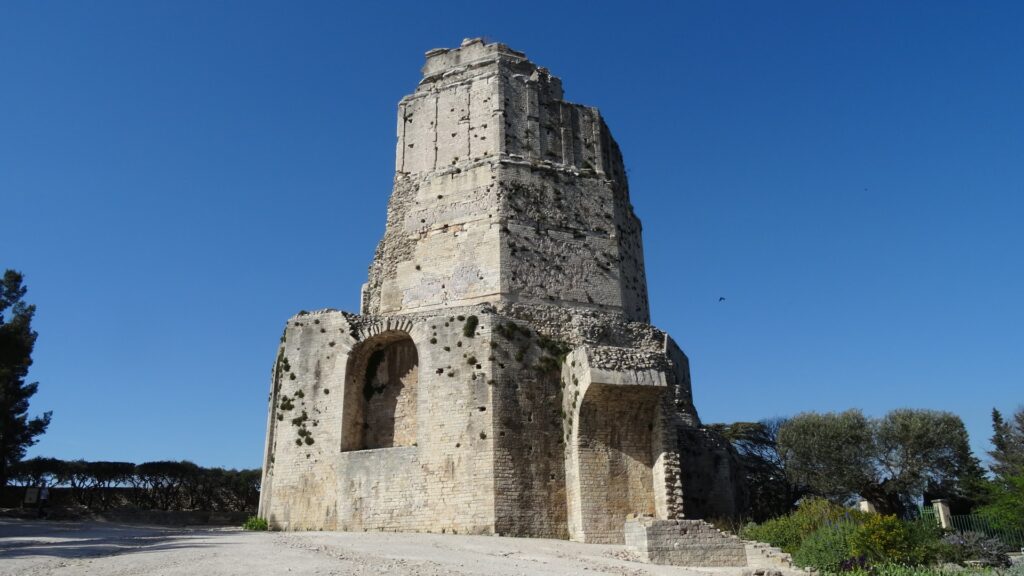
Perched proudly on Mont Cavalier at an altitude of 114 metres, the Tour Magne in Nîmes has majestically dominated the skyline of the Roman city for almost two thousand years. This octagonal stone colossus, the most imposing remnant of the ancient Roman fortifications, tells on its own the fascinating story of Nemausus, ancient Nîmes. A silent sentinel of time, the Tour Magne has come through the ages with its mystery and grandeur intact, defying the centuries as it once defied invaders. From its summit you will take in a striking panorama of the city and the surrounding hills, the same view that allowed the Romans to watch over the trade routes vital to their empire. Discover the Tour Magne in Nîmes: the history, secrets and visiting tips for this architectural gem that embodies the very soul of the Roman heritage of Nîmes, between legends of hidden treasure and the technical feats of a civilisation that never ceases to dazzle us.
A journey back in time at the Tour Magne
To round off our exploration of this iconic monument, we invite you to watch this captivating video about the Tour Magne. The aerial footage lets you appreciate the scale of this Roman construction and its strategic position overlooking the city of Nîmes. You will also see interior views rarely accessible to the general public, as well as historical reconstructions shedding light on its military and symbolic role. The video also presents the construction techniques used by Roman engineers, a testament to their exceptional architectural mastery. This audiovisual resource comes from the web and was selected to illustrate our article. It is not the property of this blog but is an ideal complement for visualising the majesty of this two-thousand-year-old testimony to Roman genius.
History and origins of the Tour Magne in Nîmes
The Tour Magne, Nîmes’ age-old sentinel, has a history as impressive as its stature. Originally built by the Gauls in the 1st century BC, this pre-Roman tower was part of a sanctuary dedicated to the god Nemausus, the protective deity of the spring that gave the city its name.
The history of this iconic monument took a decisive turn with the Roman conquest. Far from destroying it, the Romans decided to incorporate this existing structure into their ambitious urban project.
From Gallic tower to Roman monument
Around 16-15 BC, during the reign of the Emperor Augustus, the Tour Magne was considerably modified and enlarged to become the centrepiece of the Roman ramparts of Nemausus. Roman engineers raised the original structure to an impressive height of 36 metres, turning it into a strategic watchtower over the Via Domitia, the crucial route linking Italy and Spain.
The octagonal building was then clad in facing stones that gave it a majestic appearance, a symbol of Roman power and a landmark for travellers approaching the city.
The test of the centuries
The decline of the Roman Empire marked the start of a long period of neglect for the Tour Magne. Over the centuries, it served as a stone quarry for nearby buildings, gradually losing its former splendour.
In 1601, a singular event left its mark on its history: a Nîmes gardener named François Traucat, convinced that treasure was hidden there, obtained permission from King Henri IV to dig at the base of the tower. This fruitless quest further weakened the structure, requiring consolidation work that gave the Tour Magne its current silhouette.
Listed as a Monument Historique as early as 1840, the Tour Magne today bears witness to Nîmes’ extraordinary Gallo-Roman heritage and remains one of the oldest visible remains of its two-thousand-year past.
Architecture and strategic role of the Tour Magne in Antiquity
In the heart of the Roman city of Nemausus, the Tour Magne stands as the most imposing architectural witness to the fortified wall. This monumental structure, which originally rose to almost 36 metres, was much more than a simple defensive work. Its construction reflects Roman genius and the ability to integrate existing buildings into a new, coherent whole.
An ancient architectural feat
Built on the foundations of an existing Gallic tower, the Tour Magne was enlarged and remodelled by the Romans in the 1st century BC. Its octagonal architecture, typical of the Augustan style, rested on a massive square base. Archaeologists have highlighted the ingenuity of its design: three superimposed levels, the first of which was decorated with finely worked dressed-stone facing featuring characteristic rusticated bosses.
The construction technique used a core of opus caementicium, the ancestor of modern concrete, which gave the whole structure strength and durability. This revolutionary method made it possible to erect buildings of a height unmatched until then.
A multi-purpose strategic role
Positioned at the highest point of Mont Cavalier, the Tour Magne played a decisive role in the defensive system of Nemausus. This stone sentinel was a prime observation post overlooking the whole territory. It made it possible to monitor the Via Domitia, the vital trade route linking Italy and Hispania.
Beyond its obvious military function, this monumental tower was also a symbol of power. Visible for miles around, it reminded travellers and local people of the greatness of Rome and its authority over the region. It also served as a landmark for ships approaching from the Mediterranean, guiding sailors towards the city’s river port.
The Romans cleverly incorporated it into the fortified wall almost 6 kilometres long that encircled the city, which included 80 watchtowers, with the Tour Magne as its crowning glory.
How to visit the Tour Magne in Nîmes: opening hours, access and prices
The Tour Magne is open all year round so you can discover its historic wonders and its exceptional panorama. Planning your visit in advance will ensure you get the most out of this iconic Nîmes monument.
Seasonal opening hours
Access to the Tour Magne varies throughout the year. From April to September, enjoy generous opening hours from 9.30am to 6.30pm. Between October and March, hours are reduced to 9.30am to 5pm. Note that the monument is closed on 1 January, 1 May, 1 November and 25 December.
For a more pleasant experience, choose a morning or late-afternoon visit, especially in summer. That way you will avoid the tourist crowds and the intense heat.
Prices and ticket options
Admission to the Tour Magne costs €3.50 at the full rate. Reductions are available for groups and students. The combined “Pass Romanité” ticket is the best-value option if you also plan to visit the Arènes and the Maison Carrée (€13.50 for all three sites).
You can buy your tickets on site or online on the official Nîmes Tourisme website to avoid the queues.
How to get there
The Tour Magne is located in the heart of the Jardins de la Fontaine, on Mont Cavalier. There are several ways to get there:
On foot: from the city centre, allow around 15 minutes for a pleasant walk through the historic streets.
By bus: lines 2 and 10 serve the “Jardins de la Fontaine” stop close by.
By car: a pay car park is available at the entrance to the Jardins de la Fontaine, but spaces are limited in high season.
Once there, get ready to climb the 140 steps that lead to the top. The effort is well worth it for the spectacular view over Nîmes and its surroundings.
What to see around the Tour Magne: must-see sites nearby
The Tour Magne majestically overlooks the city of Nîmes, but it is not the only ancient treasure to discover in this exceptional Roman city. Once you have finished the climb and taken in the panorama, continue your exploration with these remarkable sites close by.
The Jardins de la Fontaine
At the foot of the hill, the magnificent Jardins de la Fontaine are a must-see stop. Created in the 18th century on the site of a Roman sanctuary, they are among the first public gardens in Europe. Stroll along the statue-lined paths, admire the ornamental balustrades and terraces, and enjoy the peaceful atmosphere around the central pool.
As you wander through the gardens, you will come across the Temple of Diana, an enigmatic ruin whose exact function is still debated. This partially preserved Roman building has fascinating architecture, with its barrel vault and wall niches.
The historic centre and its Roman treasures
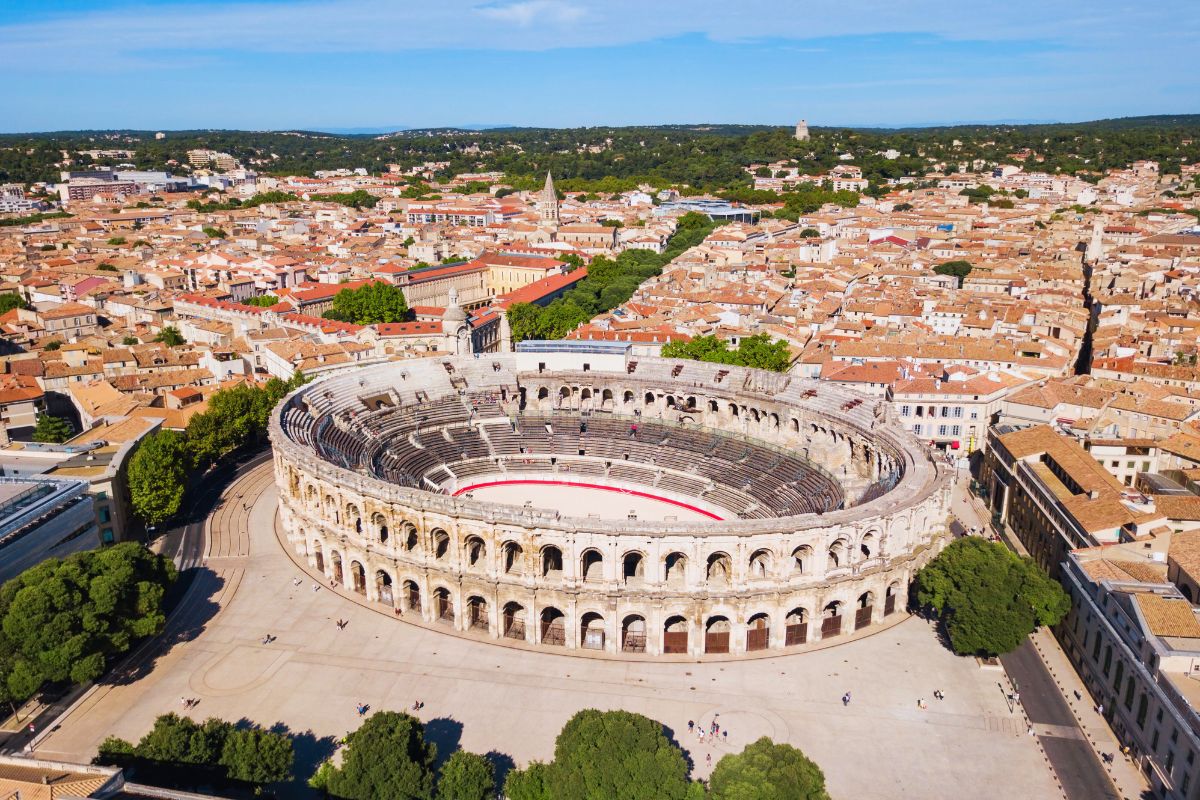
A few minutes’ walk away lies the heart of Nîmes with its exceptional monuments. The Maison Carrée, a perfectly preserved Roman temple, impresses with the elegance of its proportions. Further on, the imposing Arènes de Nîmes, a Roman amphitheatre still in use, bear witness to the greatness of the Empire.
Don’t miss the Musée de la Romanité, opposite the arena. This contemporary building, whose façade evokes a Roman toga, houses an exceptional archaeological collection tracing the ancient history of the region.
The surrounding countryside
Hikers will enjoy the waymarked trails of the Bois des Espeisses surrounding the Tour Magne. These paths offer pleasant shady walks and fine viewpoints over the surrounding garrigue and the Nîmes plain.
For a complete experience, set aside a whole day to explore these sites, which together form one of the richest collections of Roman remains outside Italy.
Legends and mysteries surrounding the Tour Magne in Nîmes
Beyond its archaeological and architectural importance, the Tour Magne is shrouded in a veil of mystery that has fed the imagination of the people of Nîmes for centuries. These legendary tales add a fascinating dimension to this iconic monument, turning a simple visit into a true immersion in local folklore.
The legend of the hidden treasure
The most famous legend dates back to the 16th century and concerns François Traucat, a gardener from Nîmes. In 1601, he obtained permission from King Henri IV to excavate at the base of the tower after supposedly discovering an ancient manuscript mentioning a fabulous treasure buried beneath the monument. The manuscript, written in mysterious characters, contained a riddle he believed he had deciphered.
Traucat dug relentlessly, dangerously weakening the structure. Unfortunately for him, no treasure was found, but his excavations forced the authorities to reinforce the base of the building. This story perfectly illustrates how the Tour Magne has always been seen as the guardian of ancestral secrets.
Popular beliefs and unexplained phenomena
Other tales surround this ancient monument. Some say that on nights of the full moon, ghostly figures of Roman soldiers stand guard around the tower. Visitors claim to have felt strange sensations while climbing its stairs, as if time flowed differently there.
The tower’s strategic position, overlooking the city and its surroundings, has also fuelled theories about its role in ancient rituals linked to the stars. Geometric alignments with other Roman monuments in the city still intrigue archaeoastronomy enthusiasts.
Whether founded or not, these legends show the deep mark the Tour Magne has left on the soul of Nîmes, transcending its simple defensive function to become a true symbol of identity steeped in mystery.
Why the Tour Magne is a symbol of Nîmes’ Roman heritage
If the Tour Magne captivates visitors so much today, it is because it embodies the Roman soul of Nîmes in a unique way. This monument is not just an impressive structure, but the most visible testimony to the greatness of ancient Nemausus.
The last remnant of the Roman ramparts
While the arena and the Maison Carrée represent public and religious life, the Tour Magne symbolises the defensive and strategic side of Roman genius. Today it is the only surviving fragment of the imposing ramparts that once encircled the city. Its recognisable silhouette has become the emblem of the resilience of this two-thousand-year-old heritage, withstanding the ravages of time when other sections of the fortifications have disappeared.
A tangible link with Roman civilisation
The tower creates a direct connection with the Roman town planning of Nîmes. From its summit, visitors can understand the layout of the ancient city and picture the line of the old ramparts. This unique perspective offers an immediate understanding of Roman strategic thinking, turning a simple monument into a genuine living history lesson.
A source of pride for the people of Nîmes
For the people of Nîmes, the Tour Magne is much more than a tourist attraction. It embodies the Roman identity deeply rooted in local culture. Its image adorns logos, publications and regional products, serving as a link between a glorious past and the present. The people of Nîmes have a special relationship with this monument, a mixture of cultural pride and sentimental attachment.
The tower also bears witness to the exceptional historical continuity of Nîmes, one of the few French cities that can boast such a remarkably preserved and showcased Roman presence. It is thus the cornerstone of a living heritage that attracts thousands of visitors every year, fascinated by this authentic Roman legacy.

The Tour Magne at a glance
The Tour Magne, Nîmes’ age-old sentinel, reveals its fascinating history and exceptional panorama. This iconic monument bears witness to the greatness of Rome and still holds a few mysteries. To help you plan your visit to this architectural gem, here is the essential information to know before climbing its 140 steps and discovering one of the oldest remains in Nîmes.
- Originally a Gallic monument from the 1st century BC, later enlarged by the Romans
- Octagonal structure once rising to 36 metres, sentinel of the Roman ramparts
- Open April to September: 9.30am-6.30pm / October to March: 9.30am-5pm
- Price: €3.50 (full rate) or Pass Romanité at €13.50 for 3 sites
- Access via the Jardins de la Fontaine, a 15-minute walk from the city centre
- Nearby sites: Temple of Diana, Jardins de la Fontaine, Maison Carrée, Arènes
An ancient beacon over Nîmes and its history
At the end of our journey through the centuries, the Tour Magne in Nîmes turns out to be much more than a mere archaeological remnant. An age-old sentinel overlooking the city from Mont Cavalier, it embodies the fascinating meeting of Gallic and Roman cultures. Its octagonal architecture, the fruit of Roman genius, reminds us of the ingenuity of our ancestors.
As you climb its 140 steps, you are not just climbing a hill but truly travelling back in time. The reward is twofold: an exceptional panorama over Nîmes and its surroundings, and that tangible connection with two thousand years of history. The Jardins de la Fontaine at its foot round off this unique experience perfectly.
Don’t wait any longer to discover this gem of Nîmes’ heritage. Whether you are passionate about Roman history, a lover of fine views or simply curious, the Tour Magne promises you a moment suspended between sky and history. It is the ideal starting point for exploring the exceptional Roman heritage of Nîmes, a city where Antiquity is in constant dialogue with our present.
Find out more about the Tour Magne in Nîmes: 3 key questions
Why was the Tour Magne so important to the Romans?
The Tour Magne was crucial to the Romans because it served at once as a watchtower offering a strategic view over the whole region, a symbol of power visible from afar, and a defensive element integrated into the system of ramparts that protected the city of Nemausus (Nîmes).
How has the Tour Magne been restored over the centuries?
The Tour Magne has undergone several major phases of restoration, notably the one ordered by François I in the 16th century following the damage caused by treasure hunter François Traucat, then the work carried out by the architect Henri Révoil in the 19th century, which gave it its current appearance and allowed this iconic monument to be preserved to the present day.
What is the best time to visit the Tour Magne and enjoy the panoramic view?
The best time to visit the Tour Magne is in spring (April-May) or early autumn (September-October), when temperatures are pleasant, the light is ideal for panoramic photos and there are fewer tourists than in the peak summer season.