Since the bullfight took on its modern form in the 18th century, hundreds of men have died on the horns. Some are household names, such as Joselito and Manolete. Most were banderilleros, picadors and novilleros whom history has forgotten. Here are the main fatal gorings, from José Cándido in 1771 to Iván Fandiño in 2017, with the sources to check them.
How many bullfighters have died in the ring?
There is no official figure. British writer Alexander Fiske-Harrison counted at least 533 professional bullfighters killed since 1700, based on the four volumes of the Spanish reference work Víctimas de la tauromaquia. He stresses that this is a minimum: amateurs and poorly documented deaths are left out.
For the 20th and 21st centuries, the Spanish press puts the toll at 138 professionals, 36 of them matadors, who died of wounds received in bullrings, on ranches or at tientas, worldwide. The Encyclopædia Britannica notes that of some 125 major matadors since 1700, more than 40 were killed in the ring. The gap depends on who is counted: matadors alone, or the whole cuadrilla.
18th and 19th centuries: the first names
José Cándido Expósito died on 23 June 1771 in the bullring of El Puerto de Santa María, aged 36. He slipped in a pool of blood while a bull was chasing him and was fatally gored. He is one of the first famous matadors killed in the ring.
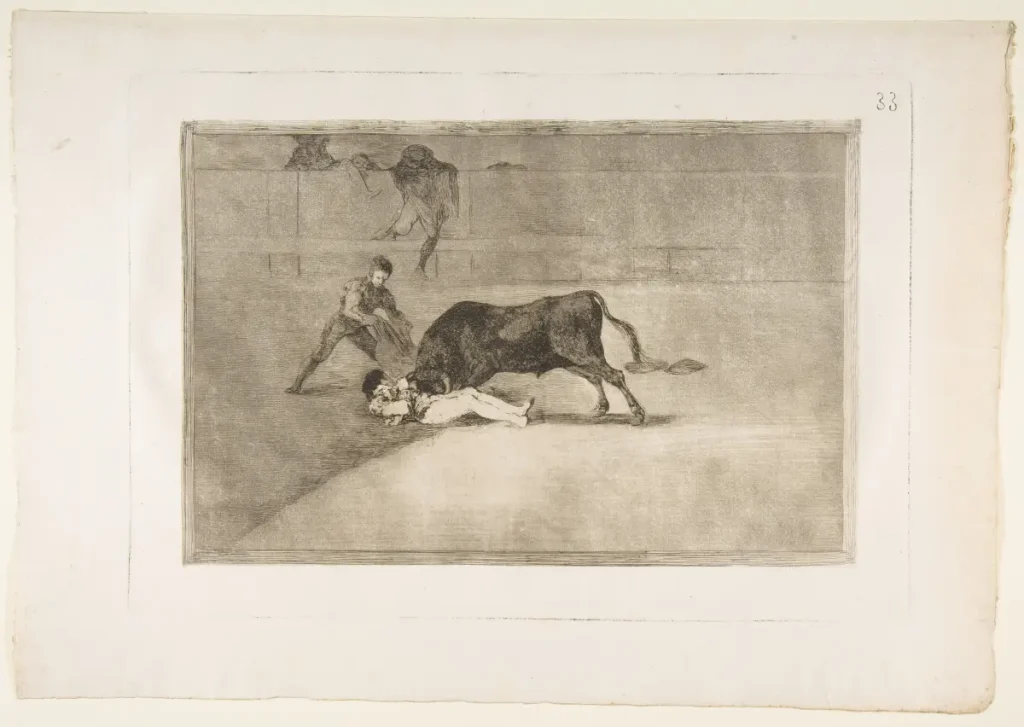
Thirty years later, on 11 May 1801, José Delgado “Pepe-Hillo”, one of the great figures of his day and the author of a Tauromaquia, was killed in Madrid by Barbudo, a bull bred by José Gabriel Rodríguez of Peñaranda de Bracamonte. The bull knocked him down as he went in for the kill and kept him on its horn for long seconds: broken ribs and vertebra, ruptured organs. Goya engraved the scene in his series La Tauromaquia (plate 33, the image at the top of this article).
Curro Guillén died on 20 May 1820 in Ronda, cradle of the Ronda school, gored while going in to kill a bull bred by José Rafael Cabrera. At the end of the century, Manuel García “El Espartero”, the idol of Seville, was killed in Madrid on 27 May 1894 by Perdigón, a Miura bull, also at the moment of the kill. He was 29.
1907-1947: the golden age and its tragedies
The first fatal goring of the 20th century happened in Mexico: Antonio Montes was wounded on 13 January 1907 in Mexico City’s old bullring by Matajacas (Tepeyahualco) and died four days later.
On 16 May 1920 the death of José Gómez Ortega “Joselito”, also known as “Gallito”, stunned Spain. At 25 he was the most complete bullfighter of his time. In Talavera de la Reina, Bailaor (or Bailador), a small bull from the widow Ortega’s ranch, nearly blind according to accounts, wounded him fatally. His rival and friend Juan Belmonte outlived him by more than forty years.
Two years later, on 7 May 1922, Manuel Granero from Valencia, aged 20, was killed in Madrid by Pocapena, bred by the Duke of Veragua: pinned against the barrier, he took the horn in his right eye. In February 1926, Manuel Báez “Litri” was gored in Málaga by Extremeño and died in hospital a week later, of gangrene according to several sources.
On 11 August 1934, Ignacio Sánchez Mejías, bullfighter, writer and friend of the Generation of ’27 poets, stood in for Domingo Ortega in Manzanares. Granadino gored him in the thigh at the start of the faena. He refused surgery on the spot, the ambulance was slow to come and gangrene set in: he died on 13 August in Madrid. Federico García Lorca wrote the Llanto por Ignacio Sánchez Mejías for him, with its famous line “a las cinco de la tarde” (“at five in the afternoon”).
Manolete, Linares, 1947
On 28 August 1947 in Linares (Jaén), Manuel Rodríguez “Manolete”, the undisputed number one of the post-war years, faced Islero, a 495 kg Miura. As he went in for the kill, the horn entered his right thigh and destroyed the femoral triangle. Manolete died the next day at 5.07 am in Linares hospital, aged 30. One theory, never settled, blames his death on a transfusion of faulty plasma rather than on the wound itself.
The 1970s and 1980s
On 25 July 1971, José Mata was gored in Villanueva de los Infantes by Cascabel (Luis Frías) and died two days later. On 11 August 1974, the Portuguese matador José Falcón, 29, was gored in the thigh at the Monumental in Barcelona by Cuchareto (Hoyo de la Gitana). He insisted on killing his bull before being treated: the artery ruptured and he died a few hours later.
On 26 September 1984 in Pozoblanco (Córdoba), Francisco Rivera “Paquirri” was caught by Avispado (Sayalero y Bandrés). The horn severed the iliac vein, the saphenous vein and the femoral artery. The infirmary could not stop the bleeding; he died that evening, during his transfer, at the military hospital in Córdoba. Footage of the goring and of the infirmary was seen all over Spain.
Less than a year later, on 30 August 1985, José Cubero “El Yiyo”, 21, who had shared the Pozoblanco bill, was killed outright in Colmenar Viejo by Burlero (Marcos Núñez): the horn pierced his heart after the sword thrust. Forty years on, his brother has spoken about that day.
The men of the cuadrilla
Banderilleros and picadors pay a heavy price, often without their names being remembered. The best-known case is Manolo Montoliu, banderillero to José María Manzanares: on 1 May 1992 at the Maestranza in Seville, during the April Fair, Cubatisto (Atanasio Fernández) caught him full in the chest after a pair of banderillas. His heart was torn, he died almost instantly and the bullfight was called off.
The 21st century: Víctor Barrio, El Pana, Iván Fandiño
For more than thirty years, no matador died in a Spanish ring. That ended on 9 July 2016 in Teruel: Víctor Barrio, 29, was gored in the chest by Lorenzo (Los Maños). The horn went in under the armpit and tore the thoracic aorta; he died within minutes. He was the first matador killed in a Spanish bullring since El Yiyo.
In Mexico, Rodolfo Rodríguez “El Pana”, 64, an eccentric figure of Mexican bullfighting, was tossed on 1 May 2016 in Ciudad Lerdo (Durango) by Pan Francés (Guanamé). Left quadriplegic, he died on 2 June 2016 in hospital in Guadalajara.
On 17 June 2017 the tragedy struck in France. In Aire-sur-l’Adour (Landes), Basque matador Iván Fandiño, 36, tripped on his cape during a quite by chicuelinas. Provechito, from Baltasar Ibán, gored him in the side: liver, lung and kidney hit, inferior vena cava severed. He died in hospital in Mont-de-Marsan. According to the press, no bullfighter had died in a French ring since Isidoro Marí “Fernando” in Béziers in 1921.
In France: remembering Nimeño II
The most painful story in French bullfighting is not on these lists. On 10 September 1989 in the Arles arena, Christian Montcouquiol “Nimeño II” from Nîmes was thrown by a bull and injured his cervical vertebrae. Left paralysed, he took his own life in November 1991. His brother Alain, who died in November 2026, told the story in Recouvre-le de lumière (read our article).
And today?
Deaths in the ring have become rare among professionals. The danger has not gone away, even outside the ring. On 3 April 2026, Ricardo Ortiz, 51, a former novillero from Málaga who had moved into event organisation, was killed by a bull in the corrals of La Malagueta, the day before the Picasso-themed corrida. Police treated it as a workplace accident. In February 2026, an aficionado died during the night-time capea of the Carnaval del Toro in Ciudad Rodrigo, the first such death in that bullring since 1986.
The main fatal gorings
| Date | Bullfighter | Bullring | Bull (ranch) |
|---|---|---|---|
| 23 June 1771 | José Cándido | El Puerto de Santa María | not named |
| 11 May 1801 | Pepe-Hillo | Madrid | Barbudo (J. G. Rodríguez) |
| 20 May 1820 | Curro Guillén | Ronda | José Rafael Cabrera |
| 27 May 1894 | El Espartero | Madrid | Perdigón (Miura) |
| 13 Jan. 1907 (†17) | Antonio Montes | Mexico City | Matajacas (Tepeyahualco) |
| 16 May 1920 | Joselito “El Gallo” | Talavera de la Reina | Bailaor (widow Ortega) |
| 7 May 1922 | Manuel Granero | Madrid | Pocapena (Veragua) |
| 11 Feb. 1926 (†1 week) | Manuel Báez “Litri” | Málaga | Extremeño |
| 11 Aug. 1934 (†13) | Ignacio Sánchez Mejías | Manzanares | Granadino |
| 28 Aug. 1947 (†29) | Manolete | Linares | Islero (Miura) |
| 25 July 1971 (†27) | José Mata | Villanueva de los Infantes | Cascabel (Luis Frías) |
| 11 Aug. 1974 | José Falcón | Barcelona | Cuchareto (Hoyo de la Gitana) |
| 26 Sept. 1984 | Paquirri | Pozoblanco | Avispado (Sayalero y Bandrés) |
| 30 Aug. 1985 | El Yiyo | Colmenar Viejo | Burlero (Marcos Núñez) |
| 1 May 1992 | Manolo Montoliu (banderillero) | Seville | Cubatisto (Atanasio Fernández) |
| 1 May 2016 (†2 June) | El Pana | Ciudad Lerdo (Mexico) | Pan Francés (Guanamé) |
| 9 July 2016 | Víctor Barrio | Teruel | Lorenzo (Los Maños) |
| 17 June 2017 | Iván Fandiño | Aire-sur-l’Adour (France) | Provechito (Baltasar Ibán) |
For the terms used here (cogida, estocada, quite, cuadrilla…), see our bullfighting glossary.
Sources: Spanish Wikipedia (entries on José Cándido, Pepe-Hillo, Curro Guillén, El Espartero, Antonio Montes, Joselito, Manuel Granero, Ignacio Sánchez Mejías, Manolete, Paquirri, El Yiyo, Manolo Montoliu, Víctor Barrio, Iván Fandiño); English Wikipedia (José Falcón, the Báez “Litri” family); Alexander Fiske-Harrison, The Last Arena; Encyclopædia Britannica; OKDiario (José Mata, 20th-century figures); Zeta Tijuana (El Pana); The Connexion (Béziers, 1921); COPE (Ricardo Ortiz); Salamanca Hoy (Ciudad Rodrigo). Illustration: Francisco de Goya, La Tauromaquia, plate 33, “La desgraciada muerte de Pepe Illo en la plaza de Madrid” (1816), Metropolitan Museum of Art, public domain (CC0).