Have you ever noticed the crocodiles that adorn the façades, fountains and monuments of Nîmes? If you have ever strolled through the streets of this southern French city, you will certainly have come across this emblematic reptile in various forms. But why the crocodile in Nîmes, and how did it become the unmissable symbol of this two-thousand-year-old city? This surprising link between a French city and an African animal hides a fascinating story that goes back to Roman antiquity. Down the centuries, the symbol has stood the test of time and is now inseparable from the identity of Nîmes.
In this article, we explore the historical origin of the crocodile chained to a palm tree, a symbol born of a Roman military victory that has shaped the visual identity of Nîmes for more than 2,000 years. From the Battle of Actium to the modern coat of arms and its influence on today’s tourism, find out how this reptile became the most recognisable emblem of a city with such a rich Roman heritage.
A visual dive into the history of the Nîmes crocodile
To explore this fascinating story of the crocodile chained to a palm tree further, we invite you to watch this captivating video entitled “Les secrets de l’AS au crocodile de Nîmes”. It explores the different facets of the city’s emblematic symbol and reveals little-known details about its origin and how it has changed over the ages. You will better understand how this exotic reptile took hold in the collective imagination of the people of Nîmes and continues to shape the cultural identity of the Roman city. This video, found online to illustrate our article, does not belong to the blog but is an ideal complement for seeing the importance of this age-old symbol.
The historical origin of the crocodile in Nîmes
The story of the crocodile as the emblem of Nîmes goes back to Roman antiquity and is rooted in a major military event that changed the city’s destiny. This unique symbol bears witness to the deep Roman influence that shaped Nîmes and gave it its highly recognisable visual identity.
The Battle of Actium: the starting point of an age-old symbol
It all began in 31 BC, at the famous Battle of Actium. This naval clash pitted Octavian, the future Emperor Augustus, against the forces of Mark Antony and Cleopatra, Queen of Egypt. Octavian’s decisive victory ended the Roman civil war and sealed the fate of the Empire. To commemorate this triumph, the emperor had a medal struck showing a crocodile chained to a palm tree, symbolising Egypt’s submission to Rome.
The veterans of the battle, rewarded for their loyalty, received land in the colony of Nemausus (the ancient name of Nîmes). These soldiers brought the victorious symbol with them, and it gradually became embedded in the city’s visual identity.
From ancient coins to the coat of arms
Coins struck in Nîmes between 28 and 27 BC attest to the early importance of the symbol. These asses of Nîmes, as numismatists call them, show on the reverse a crocodile chained to a palm tree with the inscription “COL NEM” (Colonia Nemausus). The coins circulated widely throughout the Roman Empire, linking Nîmes to the motif for good.
Several examples of these coins have been found during archaeological excavations, providing valuable evidence of this early association between the city and its emblem. The Musée de la Romanité in Nîmes holds several of these ancient coins, tangible witnesses to this two-thousand-year-old history.
The meaning of the crocodile and the palm tree in the coat of arms
At the heart of the Nîmes coat of arms, the crocodile chained to a palm tree is far more than a mere heraldic ornament. This emblematic pair tells, on its own, the story of a conquest and of an ancient heritage that has endured for more than two millennia.
An allegory of Roman victory
The symbolism of the crocodile and the palm tree comes from the Roman interpretation of the victory at Actium. The crocodile, a sacred animal in Egypt representing the Nile, here embodies the defeated Egyptian empire. Chained to the palm tree, it symbolises Egypt’s total submission to Roman power.
The palm tree, for its part, represents Judaea, which was also under Roman rule at the time. Together, the two elements convey a clear political message: Rome’s hegemony over the eastern territories of the Mediterranean.
Symbols with many meanings
Beyond simply representing a military victory, these symbols have deeper dimensions. The palm tree also evokes fertility and prosperity, suggesting the riches brought by the newly conquered provinces. Its verticality contrasts with the horizontality of the crocodile, illustrating the domination of the civilised over the wild in Roman thought.
The crocodile, a fearsome creature of the Nile marshes, also embodies the power of an age-old civilisation now brought to heel. The animal, considered divine by the Egyptians, is reduced to a trophy in Roman and later Nîmes symbolism.
A political symbol turned symbol of identity
This iconography, originally designed by Augustus as imperial propaganda, gradually became a symbol of local identity for the people of Nîmes. The “COL NEM” (Colonia Nemausus) colonial coinage, circulated throughout the Empire, tied the symbol to the city for good, until it became the unmissable emblem we know today.

How the Nîmes coat of arms has changed over the centuries
The coat of arms of Nîmes is a fascinating visual record of the city’s history. While the crocodile and palm tree date back to Roman antiquity, these emblems have undergone various transformations over the centuries, reflecting the political, artistic and cultural changes in the city.
From the medieval seal to the official coat of arms
In the Middle Ages, Nîmes already used a seal showing the palm tree and the crocodile, but in a more stylised form. It was only at the beginning of the 16th century that the coat of arms took on a more official form. In 1535 came a major event: Francis I granted the city the right to use the motto “COL NEM” (Colonia Nemausensis), strengthening the link with its Roman heritage.
The depictions also changed in style, moving from a fairly rudimentary drawing to more detailed versions in which the crocodile became more realistic. Seventeenth-century administrative documents show a reptile with well-defined scales, firmly chained to the palm tree.
The modernisation of the emblems
The French Revolution marked a first break, with an attempt to erase royal and aristocratic symbols. However, the crocodile and the palm tree survived this turbulent period because their origin was ancient rather than monarchical.
In the 19th century, the coat of arms became standardised and appeared on many public buildings constructed during this period of urban expansion. The Hôtel de Ville, built in 1823, proudly displays the coat of arms on its façade.
The contemporary revival by Philippe Starck
The most significant change of modern times came in 1985, when the famous designer Philippe Starck proposed a pared-back, contemporary version of the logo. This minimalist design, in which the crocodile and the palm tree are reduced to their essential shapes on a red background, quickly became the city’s marketing emblem.
This modernisation helped turn the Nîmes symbol into an internationally recognisable icon, marking the shift from a historic coat of arms to a genuine contemporary city logo, without ever losing its original meaning.
Why are there depictions of the crocodile all over Nîmes?
Beyond their presence in the official coat of arms, depictions of the crocodile abound in the city’s public spaces. These visible signs form a real symbolic trail through the city, reflecting the deep attachment of the people of Nîmes to their historic emblem.
Emblematic sculptures all over the city
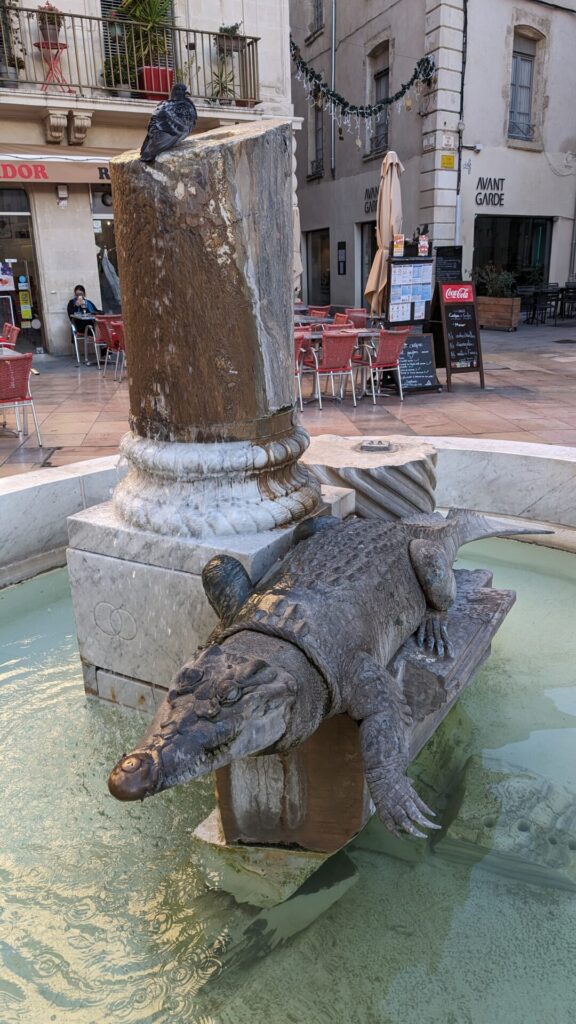
The Place du Marché is home to one of the most famous depictions of the reptile: an imposing bronze sculpture of a crocodile chained to a palm tree. This contemporary work, installed in 1993, quickly became a favourite meeting point for locals and a spot photographed by thousands of tourists every year.
The Hôtel de Ville also displays several depictions of the symbol on its façade and in its state rooms. Most of these architectural ornaments date from the 17th and 18th centuries, a period of major urban development in Nîmes.
A motif found everywhere in the heritage of Nîmes
Historic fountains, such as the one on Place d’Assas or the Pradier fountain, discreetly incorporate crocodiles into their decoration. These ornamental details form a visual signature that anchors the identity of Nîmes in the public space.
In the more recent districts, contemporary artists have reinterpreted the symbol through street art, mosaics and temporary installations. This constant reinvention of the motif shows how alive and important it remains in the local collective imagination.
A strong mark of identity in the street furniture
Manhole covers, street furniture and even some street lamps feature the crocodile motif. Since the 1990s, the municipality has chosen to systematically incorporate the symbol into its urban design, reinforcing the visual coherence and distinctive identity of the city.
The crocodile in the culture and heritage of Nîmes
Beyond the physical depictions of the crocodile throughout the city, the emblem has taken deep root in local culture and is now a central part of the area’s intangible heritage. The reptile chained to the palm tree is not just a symbol – it has become the very soul of the city.
A unifying symbol for the people of Nîmes
For the inhabitants of Nîmes, the chained crocodile is much more than a decorative feature. It is a powerful vehicle of collective identity. The people of Nîmes proudly embrace this symbol, which tells their story and speaks of their roots. It turns up in the chants of Nîmes Olympique supporters, in the work of local artists and even in the tattoos of some residents who are particularly attached to their city.
The city’s cultural associations and festive events regularly include the motif in their logos and communications. During the Feria, the symbol takes on a special dimension, bringing the generations together around a shared pride.
A source of artistic inspiration
Nîmes artists draw heavily on this symbol in their work. From painters to sculptors and craftspeople, many reinterpret the crocodile and palm tree motif. Local art galleries regularly exhibit contemporary works that revisit this historical theme.
The city also organises art competitions around the motif, encouraging creators to come up with new visions of this centuries-old emblem. This approach keeps the tradition alive while bringing it into the modern era.
Passing it on and education
The local education system includes the history of the Nîmes crocodile in its curriculum. Schools organise guided tours of the various depictions of the crocodile around the city, turning the symbol into a teaching tool for introducing younger generations to Roman history.
Creative workshops help children make this heritage their own, while the Musée de la Romanité puts on themed exhibitions tracing how the symbol has changed over the ages.

The crocodile symbol’s influence on tourism and marketing in Nîmes
The crocodile chained to a palm tree has become much more than a mere emblem for Nîmes. Over the decades, it has turned into a genuine place-marketing tool and a major tourist asset for the city. Today this historic mascot adds considerable value to the appeal of the Gard’s main city.
A marketing strategy built around the reptile
The Nîmes Tourist Office has cleverly capitalised on this strong symbol to develop a coherent and instantly recognisable visual identity. The crocodile now appears on all the city’s communication materials: brochures, posters, website and social media.
Nîmes shopkeepers have also adopted this unifying symbol. Many shops sell merchandise bearing the crocodile: T-shirts, mugs, key rings and other souvenirs that allow visitors to take a piece of Nîmes history home with them.
A themed tourist trail
To showcase this symbolic heritage, the city has created a trail called “Sur les traces du crocodile” (In the footsteps of the crocodile), allowing tourists to discover the many depictions of the animal around the city. The initiative encourages visitors to explore the city in depth beyond its flagship monuments.
The economic impact is significant: Tourist Office figures show that 65% of visitors leave with a crocodile-related souvenir. Restaurateurs even offer themed dishes and cocktails during the summer season.
International reach
The crocodile logo is now inseparable from Nîmes internationally. The clothing brand Lacoste, with its own crocodile, even collaborated with the city on a limited “Les Crocodiles de Nîmes” collection in 2018, creating a remarkable marketing synergy.
This ancient mascot, now made modern, thus helps make Nîmes known far beyond France’s borders, while strengthening residents’ sense of belonging to their city.
Key points about the Nîmes emblem
The crocodile chained to a palm tree is far more than a simple symbol for Nîmes – it has embodied the soul of the city since antiquity. To better understand this emblematic figure that has come down through the centuries, here are the essential elements that define this unique heritage and its importance to the identity of Nîmes.
- Origin linked to the Battle of Actium (31 BC), where Octavian defeated Mark Antony and Cleopatra
- Symbol of the submission of Egypt (the crocodile) to Roman power
- Featured on the “asses of Nîmes” coins from 28-27 BC
- Logo modernised by Philippe Starck in 1985
- Ever-present in the city’s public spaces: sculptures, fountains, street furniture
- A vehicle of collective identity for residents
- A major tourist asset and part of the city’s marketing strategy
The legacy of the Nîmes crocodile: a living symbol
From Roman antiquity to the present day, the question of why the crocodile in Nîmes takes us into a fascinating two-thousand-year history. This reptile chained to a palm tree, born of a military victory, has become the true cultural DNA of a city proud of its roots. More than just a coat of arms, it embodies the very soul of Nîmes and continues to evolve with it.
As you walk the streets of Nîmes, every crocodile you come across reminds you of this unbroken link between past and present. From the ancient asses of Nemausus to Philippe Starck’s contemporary designs, the emblem has come down through the centuries while reinventing itself, a sign of a lively tradition that refuses to stand still.
This symbol, now the worldwide ambassador of Nîmes, shows how a historical element can nourish the collective identity, tourism and creativity of an entire city. Whether carved into the stone of monuments, printed on souvenirs or reinterpreted by artists, the Nîmes crocodile continues to fascinate and to tell, in its own way, the extraordinary journey of a city that has preserved its heritage while looking to the future.

Find out more about why the crocodile became the emblem of Nîmes
What exactly is the historical meaning of the crocodile chained to a palm tree in the Nîmes coat of arms?
The crocodile chained to a palm tree symbolises the victory of Octavian (the future Emperor Augustus) over Mark Antony and Cleopatra at the Battle of Actium in 31 BC, representing Egypt (the crocodile) defeated and subjugated by Rome; a commemorative medal later inspired the coat of arms of the Roman colony of Nîmes.
How has the Nîmes crocodile symbol changed over the centuries?
The Nîmes crocodile symbol evolved from a design on Roman coins (the as of Nîmes) into an official element of the city’s coat of arms in the Middle Ages, then underwent a major modernisation in 1985 with the logo designed by Philippe Starck, before finally becoming the marketing symbol seen everywhere in the city and on its merchandise today.
Where can you see the most remarkable depictions of the crocodile in Nîmes today?
The most remarkable depictions of the crocodile in Nîmes can be found on the Pradier fountain (Place de la Maison Carrée), on the city’s manhole covers, in the collections of the Musée de la Romanité, on the façade of the Hôtel de Ville, and on the many sculptures and items of street furniture scattered around the historic centre.