Have you ever wondered what a goyesca corrida is? Picture a traditional corrida blended with the flamboyant art of Francisco de Goya. This unique form of bullfighting marries the spectacle of the ring with an artistic tribute. Let me invite you into the fascinating world of goyesca corridas, where toreros wear costumes inspired by the 18th century and the arenas are dressed in sumptuous decor. You will discover the history, traditions and cultural significance of this emblematic Spanish event, which lives on to this day.
The origin and history of the goyesca corrida
You are surely wondering where this fascinating tradition, the goyesca corrida, comes from. Its history goes back to the 18th century, the era of the famous Spanish painter Francisco de Goya. This great master of painting was passionate about bullfighting and made it a recurring subject of his work.
It was in 1815 that Goya produced his famous series “La Tauromaquia”, made up of 33 engravings illustrating the art of the corrida. These works had a considerable impact on Spanish bullfighting culture. They inspired a new form of taurine spectacle: the goyesca corrida.
The first official goyesca corrida took place in 1954 in Ronda, birthplace of the legendary matador Pedro Romero. The idea was to recreate the atmosphere of corridas in Goya’s time, in period costume. It was an immediate success and the tradition was born.
Since then, goyesca corridas have become eagerly awaited events in the bullfighting world. They combine the art of tauromachy with a unique artistic and historical dimension. I was lucky enough to attend one in Arles, and I can tell you it is an unforgettable spectacle!
Costume and appearance of goyesca toreros
Inspired by Francisco de Goya
One of the most striking aspects of a goyesca corrida is undoubtedly the toreros’ costume. When I saw these matadors enter the ring, I felt as though I had been transported into a Goya painting!
The costumes are directly inspired by the outfits worn by 18th-century toreros, as depicted in Goya’s works. They differ considerably from the modern suits of lights usually seen in traditional corridas.
Distinctive features of the costumes
The characteristic elements of a goyesca costume include:
– A short, richly embroidered jacket called a “chaquetilla”
– A waistcoat decorated with intricate patterns
– A shirt with a jabot and lace cuffs
– Breeches fastened at the knee
– Silk stockings
– Buckled shoes
These outfits are often made from luxurious fabrics such as velvet or silk. The colours are generally darker and more restrained than those of modern costumes.
How a goyesca corrida unfolds and its rituals
Although a goyesca corrida generally unfolds in much the same way as a classic corrida, certain aspects make it unique. I was struck by the special atmosphere that reigns at these events.
The spectacle often begins with a parade of the participants in period costume. It is a magical moment when you really feel you have stepped back in time. The picadors arrive on horseback, dressed as in Goya’s day.
The toreros’ passes and movements remain the same as in a traditional corrida. The atmosphere, however, is different. There is a solemnity, a respect for history and art that can be felt in every gesture.
Decoration and atmosphere in the arena
Stylistic and artistic decor
The arenas are transformed into true works of art for goyesca corridas. I was dazzled by the richness of the decorations the first time I attended one in Arles.
The stands are adorned with tapestries and hangings featuring patterns inspired by Goya’s era. Reproductions of his works are often displayed in strategic places. The whole creates a unique atmosphere, blending taurine tradition with artistic tribute.
The influence of Goya’s art
Goya’s influence is not limited to the costumes and decorations. It permeates the whole atmosphere of the event. The posters announcing the corrida are often inspired by the painter’s style. Even the music played during the spectacle may be chosen to evoke 18th-century Spain.
Emblematic venues hosting goyesca corridas
Ronda and the Feria de Pedro Romero
Ronda, the birthplace of the goyesca corrida, remains the most emblematic place to attend this kind of event. Every year in September, the town holds the Feria de Pedro Romero. The festivities include a goyesca corrida that attracts aficionados from all over the world.
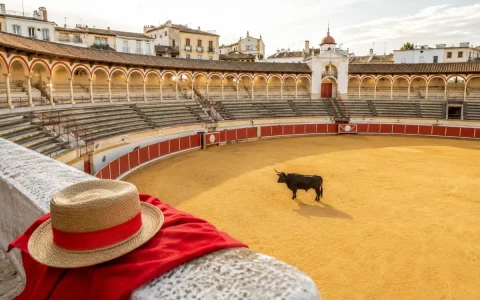
Ronda’s bullring, the oldest in Spain, offers an exceptional setting. Imagine yourself sitting in those stands steeped in history, admiring the spectacle as generations before you have done!
Arles and the Feria du Riz
In France, it is in Arles that the tradition of the goyesca corrida is most alive. The Feria du Riz, in September, is a chance to attend a goyesca spectacle in the town’s magnificent Roman arena.
I attended a few years ago and the experience was truly unique. Seeing these period costumes in a 2,000-year-old amphitheatre creates a striking and unforgettable contrast.
Cultural events associated with goyesca corridas
Bringing together music and art
Goyesca corridas are often at the heart of wider cultural events. In Ronda as in Arles, they are accompanied by art exhibitions, concerts of Spanish classical music and talks on the history of bullfighting.
These events help place the goyesca corrida in its historical and artistic context. They offer a complete cultural experience that goes well beyond a simple taurine spectacle.
The cultural and artistic significance of goyesca corridas
Goyesca corridas are much more than a simple bullfight in period costume. They embody a bridge between the past and present of Spanish culture.
For aficionados, it is a chance to reconnect with the roots of bullfighting. For art lovers, it is a living way to immerse themselves in Goya’s world. And for everyone, it is a moment when history comes spectacularly to life.
Personally, I was struck by the aesthetic beauty of the whole thing. The costumes, the decor, the toreros’ gestures… Everything combines to create a living tableau that pays tribute to Goya’s art while celebrating a centuries-old tradition.
Goyesca corridas also play an important role in preserving cultural heritage. They keep alive sewing, embroidery and craft techniques that might otherwise be lost.
Finally, they raise interesting questions about how traditions evolve and their place in modern society. They invite us to reflect on how we perceive and preserve our cultural heritage.
A living tradition that transcends time
In exploring together what a goyesca corrida is, we have delved into the heart of a fascinating tradition that blends art, history and bullfighting. These unique spectacles transport us to 18th-century Spain, reviving the spirit of Francisco de Goya through sumptuous costumes and breathtaking decor.
I was lucky enough to attend a goyesca corrida in Arles, and I can assure you it is an unforgettable experience. The atmosphere in the arena is simply magical. You feel as though you have been transported into a Goya painting, surrounded by vivid colours and graceful gestures.
These events are much more than a simple bullfight. They represent a bridge between past and present, reminding us of the importance of preserving our cultural heritage. Whether you are passionate about bullfighting or an art lover, a goyesca corrida will move and surprise you.
I warmly encourage you to enjoy this unique experience, whether in Ronda, the cradle of the tradition, or in Arles, during the famous Feria du Riz. You will come away with your head full of memories and a new appreciation for this living art that is bullfighting.
And who knows? Perhaps, like me, you will fall under the spell of these toreros in period costume, moving gracefully in an arena transformed into a true work of art. The goyesca corrida is a journey through time, a celebration of Spanish culture and, above all, a moment of pure magic.