As the Feria de Nîmes approaches, debates about bullfighting spectacles are resurfacing on social media. Yet behind the generic term “bullfighting” lie very different practices, often confused in the controversies. Between spectacles where the bull is killed and traditional games, age-old traditions and modern innovations, it is time to set the record straight so that everyone can form an informed opinion.
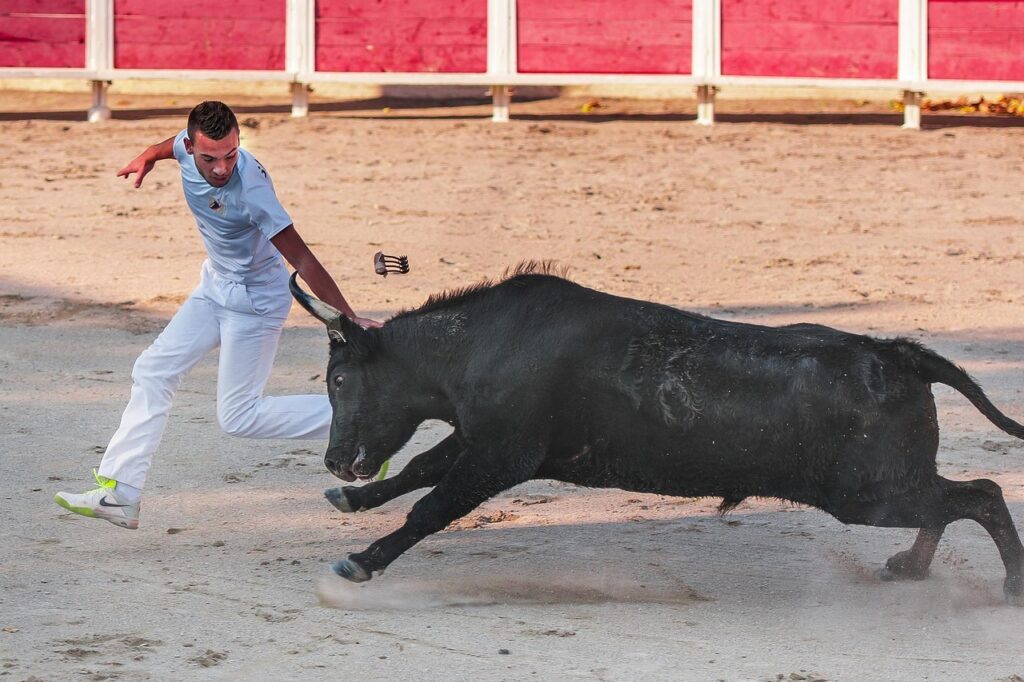
The Course Camarguaise: the art of the raset
Let’s start by clearing up a common confusion: the course camarguaise has absolutely nothing to do with the corrida. In this purely French tradition born in the Camargue, the animal remains intact and unharmed.
The principle is simple but spectacular: raseteurs dressed in white try to snatch attributes (a red cockade, white tassels, string) fixed between the bull’s horns using a metal hook. Camargue bulls, bred specially for this practice, develop intelligence and agility over the course of the races. Some become real stars, respected and pampered throughout a career that can last more than 15 years.

Contrary to the misconceptions spread by certain images taken out of context on social media, the course camarguaise celebrates the animal as much as the man. The bravest bulls are honoured, and they retire in the best possible conditions.
The Course Landaise: elegance and tradition from the South-West
Another little-known French tradition: the course landaise of the Landes and the Gers. Here too, the animal is left unharmed. The protagonists are racing cows (called “vaches landaises”) in front of which écarteurs and sauteurs perform.

The écarteur, dressed in a traditional white and red costume, performs dodges calculated to the millimetre, called “écarts”, in the face of the animal’s charges. The sauteur, for his part, leaps over the cow in a spectacular jump. The beauty of the spectacle lies in the precision of the gestures, the elegance of the movements and the mutual respect between man and animal.
The Recortadores: acrobatics in front of the bull
Originating in Spain, recortadores shows feature men who face the bull without cape or sword, relying solely on their agility. The animal remains intact: the aim is to perform spectacular acrobatic figures by dodging, jumping or sliding around the animal.

These performances demand exceptional courage and physical fitness. Recortadores develop impressive techniques: the angel jump, back flips, slides… The bull returns to the corrals after the show.
The Forcados: the Portuguese tradition
In Portugal, the forcado tradition keeps alive a ritual unique in the world. After the work of the cavaleiro (horseman) who faces the bull on horseback, eight men in traditional costume (the forcados) bring the animal to a standstill with their bare hands.

This display of collective courage, in which killing the bull is prohibited by Portuguese law, perfectly illustrates how bullfighting traditions can evolve. The bull, respected for its bravery, is not killed in the ring.
The Corrida
The traditional Spanish corrida, also practised in the south of France, follows a strict protocol divided into three tercios ending with the kill. The matador, accompanied by his cuadrilla, faces the bull according to precise rules inherited from centuries of tradition.

The modern corrida strictly regulates how the spectacle unfolds. Fighting bulls, raised in semi-freedom on vast dehesas, live a very different existence from industrial livestock. The ritual, steeped in complex aesthetic codes, values the animal’s courage as much as the torero’s art.
This form of bullfighting stands out for its artistic and cultural dimension, recognised in several countries as intangible heritage.
The Corrida de Rejón: equestrian elegance
In the corrida de rejón, the rejoneador faces the bull on horseback. This form of bullfighting, considered by many to be the most aesthetic, highlights the harmony between the rider and his mount in front of the bull.

The rejoneador’s art consists of placing rejones (short lances) with precision while keeping perfect control of his horse. This discipline, in which the bull is killed, demands exceptional horsemanship and offers a spectacle of great visual beauty.
Understanding in order to debate better
This diversity of bullfighting spectacles illustrates the richness and complexity of a cultural heritage often reduced to oversimplifications. Whether one is for or against certain practices, a precise knowledge of each of them allows for a more nuanced and respectful debate.
At a time when traditions are evolving and adapting to contemporary sensibilities, some spectacles that preserve the animal’s integrity are gaining popularity while others maintain their ancestral rituals. What matters is that everyone can form an opinion with full knowledge of the facts, far from confusion and lumping everything together.
The Feria de Nîmes, with its varied programme, offers precisely this opportunity to discover that diversity. It is then up to each person to choose the spectacles that match their values, in full knowledge of the facts.