At the heart of the city of Nîmes stands the majestic Maison Carrée in Nîmes, one of the best-preserved Roman temples in the world. This architectural gem, more than 2,000 years old, fascinates with its elegant silhouette, perfect proportions and exceptional state of preservation. A silent witness to the passing centuries, this ancient monument has come down through the ages by constantly reinventing itself, going from Roman temple to church, then to museum. Its recent inscription on the UNESCO World Heritage list in 2023 finally confirms its outstanding universal value.
Curious about this architectural masterpiece that has inspired famous buildings around the world? Discover the Maison Carrée in Nîmes: its fascinating history since Roman times, the secrets of its remarkable Corinthian architecture, and all the essential information to plan your visit. From its imperial origins through its successive transformations to its decisive influence on neoclassical architecture worldwide, this article reveals why this temple is a unique testimony to Roman town planning and remains a must-see of French heritage today.
A visual dive into the ancient history of Nîmes
To complete our presentation of this architectural gem, we invite you to discover a guided video tour of the Maison Carrée. This sequence lets you appreciate the details of this exceptional Roman temple from different angles. You will see its majestic Corinthian colonnade, its harmonious proportions and the architectural features that have survived two millennia. The video showcases this iconic monument, now a UNESCO World Heritage site. It offers a foretaste of the experience awaiting you on your visit to Nîmes. Please note that this video was found on the web to illustrate our article and is not the property of this blog.
History and origins of the Maison Carrée in Nîmes
In the heart of Roman Gaul, the Maison Carrée was built between 10 and 5 BC, during the reign of Emperor Augustus, founder of the Roman Empire. This prestigious temple was no ordinary building: it was part of a vast urban development programme for the colony of Nemausus (Nîmes), then a flourishing Roman city endowed with many monumental buildings.
Contrary to what its current name suggests, this temple is not actually square but rectangular. The name “Maison Carrée” (Square House) appeared late, in the 16th century, when the people of Nîmes began to refer to this harmoniously proportioned building in this way.
A dedication to the princes of youth
The building was dedicated to Augustus’s grandsons and heirs, Gaius and Lucius Caesar, nicknamed the “Princes of Youth”. This dedication was discovered by studying the holes left by the bronze letters that once adorned the pediment. An imperial tribute that reveals the political importance of Nîmes within the Empire.
The premature deaths of the two princes in AD 2 and 4 turned this temple, intended for the imperial cult, into a true memorial, reinforcing its symbolic and sacred dimension in the city.
A survivor of history
If the Maison Carrée has come down to us in an exceptional state of preservation, it is thanks to its many reuses over the centuries. As early as the 4th century, with the decline of paganism, the temple was closed and then converted into a Christian building. In the Middle Ages, it became in turn a consular residence and then a stable, before housing the departmental archives in the 18th century.
This adaptability explains its survival, unlike many other Roman temples dismantled for their materials or destroyed out of rejection of paganism. A remarkable destiny that today makes this temple one of the best preserved in the Roman world.
Architecture and features of the Roman temple
The architectural elegance of the Maison Carrée bears witness to the genius of Roman builders. Built between 10 BC and the beginning of the 1st century, this temple is one of the most accomplished surviving examples of Roman religious architecture. Its architectural design scrupulously respects Vitruvian canons while adding local adaptations that make it a unique model.
A hexastyle pseudoperipteral structure
The Maison Carrée is a hexastyle pseudoperipteral temple, meaning that it has six columns on its façade (hexastyle) and half-columns engaged in the side walls, giving the illusion of a complete peristyle (pseudoperipteral). This configuration saved space while preserving the building’s majestic appearance. Its perfectly balanced dimensions – 26 metres long, 15 metres wide and 17 metres high – create a visual harmony that explains its architectural legacy.
The Corinthian order and its ornaments
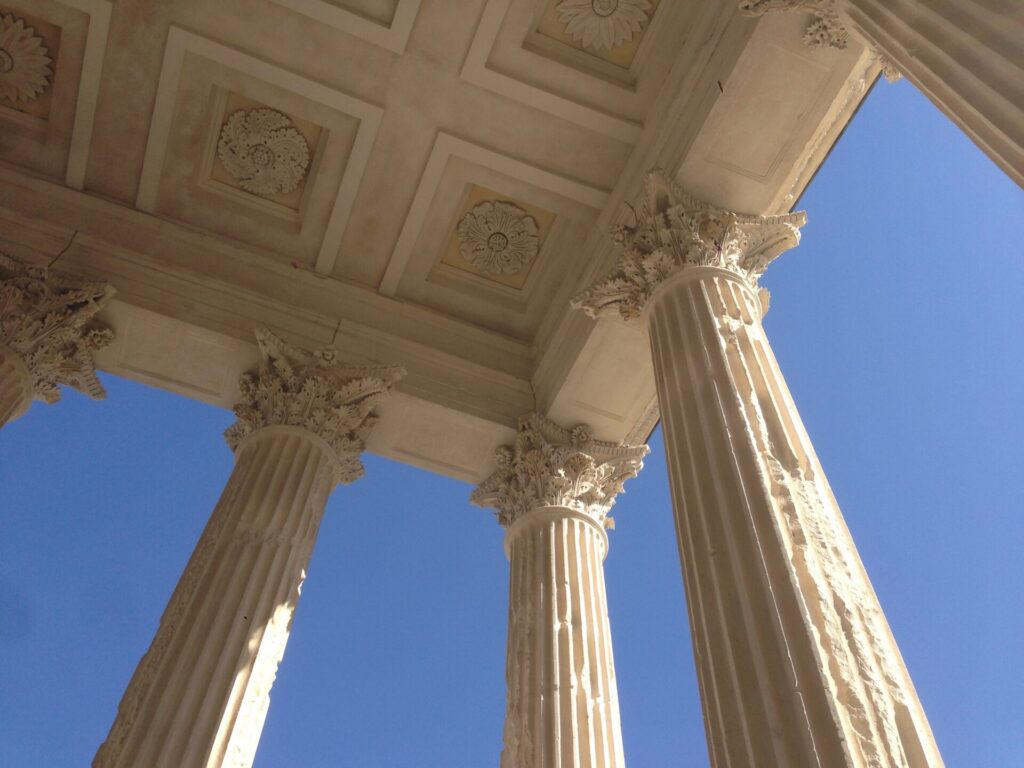
The temple stands out for its magnificent Corinthian columns topped with capitals richly decorated with carved acanthus leaves. The finesse of the details is remarkable: friezes decorated with plant scrolls, modillions and dentils beneath the cornice, and a triangular pediment that once held a sculpted group now lost. The whole rests on a podium raised almost 3 metres, reached by a monumental staircase at the front.
Materials and construction techniques
The builders mainly used local limestone for the building. The care taken in fitting the blocks is such that some joints are barely visible after two millennia. The cella (inner chamber) was dedicated to the imperial cult. Its barrel vault and thick walls ensured perfect acoustics and controlled light thanks to strategically placed openings. This technical mastery explains the monument’s extraordinary longevity, as it has withstood the ravages of time better than most contemporary buildings.

The successive transformations and uses of the Maison Carrée
From its construction at the beginning of our era to the present day, the Maison Carrée has had an eventful history, transforming over the centuries to adapt to the needs of each era. Originally devoted to the imperial cult, this temple has come down through the ages changing function several times, which partly explains its extraordinary preservation.
From Roman temple to Christian building
After the fall of the Roman Empire and the advent of Christianity, the pagan temple lost its original religious function. It was converted into a Christian church in the 5th century, dedicated to Saint Stephen, thereby escaping the destruction that befell many pagan temples. This conversion was the first major turning point in the monument’s history and ensured its preservation for centuries to come.
In the 12th century, the building became the property of the Augustinian canons, who incorporated it into their religious complex. Minor architectural modifications were made to adapt it to Christian worship, without significantly altering its structure.
From consular house to contemporary uses
The modern era saw the Maison Carrée change function once again. In the 16th century, it was converted into a consular house – hence its current name – serving as the seat of municipal power in Nîmes. Later, during the French Revolution, it went through less glorious periods, briefly serving as a stable and then a warehouse.
The 19th century marked a turning point with a new awareness of heritage. The building became the departmental archives and then, in 1823, was turned into a museum. This museum use continues today, with the film “Nemausus, the birth of Nîmes” screened inside since 2011, offering visitors an immersion in the history of the Roman city.
Successive restoration campaigns
These changes of use were accompanied by numerous restorations. The most notable remains the one led by the architect Victor Grangent in the early 19th century, which restored the monument’s ancient appearance. More recently, between 2006 and 2011, an ambitious restoration campaign cleaned the façades, revealing the original beauty of the limestone and the sculptural details of this architectural masterpiece.
Why the Maison Carrée is an influential architectural model
From the Roman temple in Nîmes to major official buildings around the world, the Maison Carrée has exerted considerable architectural influence over the centuries. Its reach extends far beyond France’s borders and it continues to inspire contemporary architects and builders.
A model for neoclassical architecture worldwide
The Maison Carrée is one of the most perfect examples of classical Roman architecture. Its exceptional preservation made it an essential reference for the neoclassical movement of the 18th and 19th centuries. Thomas Jefferson, future President of the United States, fell in love with this temple during his stay in France in 1785. He called it “the most perfect model of ancient architecture” and drew directly on it to design the Virginia State Capitol in Richmond.
In France, the Église de la Madeleine in Paris clearly echoes the proportions and aesthetics of the Nîmes temple. The same resonance can be found in Birmingham’s Royal Exchange in England and Berlin’s Neue Wache. These buildings bear witness to the universality of the architectural model offered by the Maison Carrée.
The perfect balance of proportions
The Maison Carrée’s power to inspire lies in its harmonious proportions. The ratio between the height of the columns, the elevation of the pediment and the size of the podium creates a perfect visual balance. Architects from all over the world have studied these measurements to understand the “golden ratio” as applied to ancient architecture.
The apparent simplicity of the rectangular plan, the elegance of the portico and the finesse of the sculpted decoration offer a model of balance between monumentality and lightness that continues to fascinate. The most influential architectural treatises, such as Palladio’s, analysed and spread these principles, thus perpetuating the influence of the Nîmes temple.
A contemporary source of inspiration
Even today, the Maison Carrée inspires contemporary architects. Its influence can be found in the design of many museums, official buildings and even private homes. The architect Norman Foster has acknowledged drawing on its proportions for some of his creations, as have several architects of the postmodern movement.
Contemporary art exhibitions are regularly held inside the temple, creating a fascinating dialogue between the ancient and the modern. This ability to transcend eras confirms the Maison Carrée’s status as a universal architectural symbol.
Visiting the Maison Carrée in Nîmes: information and tips
Now that you know the history, architecture and influence of this ancient gem, it is time to plan your visit. The Maison Carrée awaits you for a unique experience in the heart of ancient Nemausus. Let’s go through all the practical information you need to make the most of this monument recently added to the World Heritage list.
Practical information and opening hours
The Maison Carrée stands on the square of the same name, easily reached from Nîmes city centre. Open all year round, it welcomes visitors at times that vary with the seasons: from 9.30am to 7pm in summer (April to September) and from 10am to 6pm in winter (October to March).
Admission is €5 full price, with reductions for students, seniors and groups. The combined “Arènes-Maison Carrée-Tour Magne” ticket offers excellent value at €13, ideal for exploring all of the city’s Roman heritage.
The best visiting experience
The visit has two highlights. Outside, take the time to admire the 30 Corinthian columns and the triangular pediment from different angles. Inside, you will discover an immersive film retracing the founding of Nîmes, screened in a comfortable air-conditioned room.
To avoid the crowds, visit early in the morning or late in the afternoon. The golden light of morning or sunset enhances the limestone columns and offers excellent photo opportunities.
Tips to enrich your experience
Round off your visit with a break in one of the cafés on the square, which offer a superb view of the monument. Architecture lovers will enjoy comparing the Maison Carrée with the Carré d’Art, Norman Foster’s contemporary building directly opposite.
For families, educational booklets are available at reception. Guided tours, held several times a day in high season, reveal many details invisible at first glance and are well worth the €3 supplement.
The Maison Carrée and its UNESCO World Heritage listing
International recognition of the Maison Carrée in Nîmes reached a decisive milestone on 27 September 2023. After years of candidacy and preservation efforts, this Roman temple officially joined the prestigious UNESCO World Heritage list, confirming its outstanding universal value.
A demanding application process
World Heritage status is not easily obtained. The Maison Carrée’s application was part of a wider bid entitled “Nîmes, Antiquity in the present”. This ambitious project set out to show how the city has preserved its ancient heritage and integrated it into its contemporary urban development.
UNESCO’s experts recognised the monument’s exceptional authenticity and remarkable integrity. Unlike many Roman remains, the Maison Carrée has come down to us almost intact, retaining most of its original structure.
The decisive criteria for UNESCO
Several factors weighed in the World Heritage Committee’s decision. First, the Maison Carrée is a unique architectural testimony to Roman provincial town planning. Its exceptional preservation makes it possible to study ancient construction techniques in their original context.
Second, its considerable influence on neoclassical architecture worldwide gives it a universal dimension. From Thomas Jefferson to Jacques-Germain Soufflot, the greatest architects have drawn inspiration from its perfect proportions.
The implications of this recognition
This World Heritage listing gives the monument additional protection and strengthens its international appeal to tourists. The city of Nîmes has committed to implementing a rigorous management plan to ensure its long-term preservation.
Specific measures now include tighter control of the temple’s immediate surroundings and constant monitoring of its state of preservation. Enhanced educational programmes also help visitors better understand the historical and architectural importance of this jewel of Antiquity.
Key facts about the Maison Carrée
The Maison Carrée in Nîmes, a true Roman architectural gem, deserves your attention for its fascinating history and exceptional preservation. Built between 10 and 5 BC, it has come down through the ages changing function several times – Roman temple, Christian church, consular house, archives and today a museum space. Its hexastyle pseudoperipteral architecture and perfect proportions have made it a worldwide reference that has inspired many prestigious buildings, including the Virginia State Capitol. Discover this unique heritage, recently inscribed on the UNESCO World Heritage list, which continues to fascinate visitors and architects alike.
- Built between 10 and 5 BC under Augustus, dedicated to the “Princes of Youth”
- Hexastyle pseudoperipteral temple of the Corinthian order with harmonious proportions
- A model for neoclassical architecture worldwide (Jefferson, Palladio)
- Inscribed on the UNESCO World Heritage list in September 2023
- An essential visit in Nîmes, with an audiovisual screening on the history of the city
A Roman treasure at the heart of our heritage
At the end of our journey through the centuries, the Maison Carrée in Nîmes proves to be far more than a mere ancient monument. Miraculously preserved for two millennia, this temple offers us an exceptional testimony to Roman architectural genius and to our ability to pass this heritage on to future generations.
Its recent inscription on the UNESCO World Heritage list finally confirms its outstanding universal value. From the slender Corinthian columns to the meticulous sculpted details, every element tells a story of refinement and technical excellence that architects the world over continue to study and admire.
On your next visit to the south of France, take the time to contemplate this masterpiece in the golden light of Nîmes. Observe how this monument converses with the modern Carré d’Art opposite, creating a striking bridge between Antiquity and the present day.
The Maison Carrée in Nîmes is not frozen in the past but very much alive, continuing to inspire and amaze. It reminds us that some human creations, through their beauty and perfect harmony, transcend time and move us today with the same force as two thousand years ago.
To learn more about the Maison Carrée in Nîmes: 3 key questions
Why is the Maison Carrée in Nîmes called that when it isn’t square?
The name “Maison Carrée” comes from a popular translation of the Occitan “maison carrée”, which in the Middle Ages referred to a well-proportioned building with right angles, not square in the geometric sense, since the temple measures about 26 metres long by 15 metres wide.
What architectural influence has the Maison Carrée had on famous modern buildings?
The Maison Carrée directly inspired several major neoclassical buildings such as the Église de la Madeleine in Paris, the Virginia State Capitol designed by Thomas Jefferson, and many government buildings in the United States, bearing witness to its lasting influence on Western architecture.
How has the Maison Carrée survived so intact for almost 2,000 years?
The remarkable preservation of the Maison Carrée is explained by its successive conversion into a Christian church in the 4th century, a town hall in the Middle Ages and then the departmental archives in the 18th century, which spared it from being demolished like so many other Roman monuments.