Fascinated by the bullfighting tradition but puzzled by how it unfolds? Step into the heart of the ring to discover the secrets of this ancestral art! How does a corrida unfold? From the majestic paseo to the final estocada, every stage of this captivating spectacle will be revealed to you. Get ready to experience the intensity of a corrida, where bravery, technique and emotion intertwine in a fascinating ballet between man and bull. I invite you to follow, step by step, the course of a traditional corrida, from the entrance of the protagonists to the crucial moment of the estocada, by way of the famous tercios that set the rhythm of this unique spectacle.
The start of the corrida with the Paseo
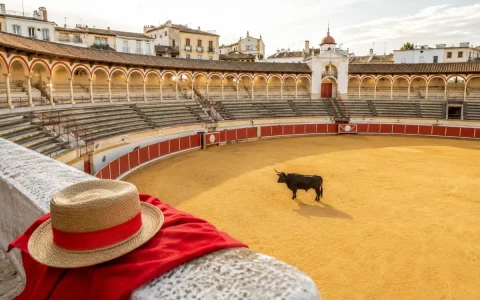
Picture yourself in the stands of a Spanish bullring, the sun burning on your skin, excitement palpable in the air. Suddenly, the trumpets sound! It is the long-awaited signal for the start of the paseo, the opening parade of the corrida.
Presentation of the participants in the ring
The gates open and the solemn procession begins. At the front, the alguaciles on horseback, dressed in traditional black costumes, lead the way. They are followed by the matadors, the undisputed stars of the show, resplendent in their trajes de luces (suits of lights) embroidered with gold and silver.
Behind them come their teams: banderilleros and picadors, essential to the smooth running of the corrida. The parade ends with the monosabios, assistants in red shirts responsible for looking after the ring. This majestic entrance, set to the rhythm of the paso doble, sets the tone for the spectacle to come.
The role of the president of the corrida
Perched in his box, the president oversees the whole spectacle. His role is crucial: he is the one who gives the go-ahead for each phase of the corrida by waving his coloured handkerchiefs. White for the bull’s entrance, orange for the banderillas, green for an exceptional pardon… Each gesture has its own precise meaning.
I remember my first corrida in Seville, where the president kept a perfect rhythm throughout the afternoon, contributing greatly to the intensity of the spectacle. His expertise and impartiality are essential to ensure that traditions are respected and the contest is fair.
The Sorteo: drawing lots for the bulls
Once the paseo is over, it is time for the sorteo, a less visible but equally important stage. This is when the fate of the bulls is sealed.
Allocating the bulls among the matadors
Behind the scenes of the bullring, away from the public’s gaze, a crucial ceremony takes place. Representatives of each matador gather to draw lots for the bulls. Each lot of two bulls is allocated to a matador, thus determining the order of appearance and each man’s opponents.
This apparently simple process is in fact fraught with tension. The matadors and their teams carefully scrutinise the characteristics of each animal, hoping to draw the “lucky number”. A bull can make or break a torero’s career.
The importance of the sorteo for the course of the spectacle
The sorteo is much more than a mere administrative formality. It directly influences the dynamics of the whole corrida. An experienced matador such as Manuel Benítez “El Cordobés” knows that the draw can be decisive for his performance.
I attended a corrida at the Madrid bullring where the young matador of the day drew a particularly combative bull. His courage against this formidable opponent earned him an ovation from the crowd, propelling his career forward. That is what is at stake in the sorteo: creating unique encounters that will live long in the memory.
First phase: the Tercio de Varas
Silence falls over the ring. The gates of the toril open with a metallic crash. The bull makes its entrance, marking the start of the first tercio: the tercio de varas.
The role of the picadors and the use of the varas
Mounted on their padded horses, the picadors come onto the scene. Armed with their long lances, the varas, their task is to test the bull’s bravery and weaken it slightly ahead of the following phases.
The picador, motionless on his mount, waits for the bull’s charge. At the moment of impact, he drives his vara into the animal’s withers. This action, however brutal it may seem, is meticulously regulated. The depth and duration of the pic are strictly controlled by the president.
The influence of the tercio on the bull’s behaviour
This first encounter is decisive for the rest of the corrida. It makes it possible to assess the bull’s strength and character, while slightly altering its posture. A bull that charges the picadors vigorously earns the respect of the crowd and promises a fine fight.
I recall a corrida in Seville where a particularly combative bull stood up to the pics with such spirit that the crowd called for its indulto (pardon). That shows just how important this phase is for the rest of the spectacle!
Second phase: the Tercio de Banderillas
The sound of the clarines announces the end of the tercio de varas. Now it is the turn of the tercio de banderillas, a phase in which agility and precision take pride of place.
The peones and the matador at work with the banderillas
The banderilleros, members of the matador’s team, enter the ring. Their mission: to place pairs of banderillas, those sticks decorated with coloured ribbons, in the bull’s back. Each placing of the banderillas is a genuine exercise in skill and courage.
The banderillero attracts the bull’s attention, encourages it to charge, then at the last moment, in a graceful movement, arches over the horns to plant his banderillas. Three pairs must be placed in all, sometimes by the matador himself, who may choose to do so to demonstrate his bravery.
Assessing the bull’s reaction
This tercio not only prepares the bull for the final phase, but also makes it possible to observe its reactions closely. How does the animal respond to the banderillas? Does it keep its fighting spirit? This information is invaluable to the matador, who will adjust his strategy accordingly.
At a corrida at Las Ventas in Madrid, I saw a matador place the banderillas himself with such mastery that the whole crowd rose as one to acclaim him. It is in moments like these that you grasp the full artistic dimension of bullfighting.
Third phase: the Tercio de Muleta
The trumpets sound again, marking the start of the final and most eagerly awaited tercio: the tercio de muleta. This is when the matador faces the bull alone, armed only with his sword and his muleta, the famous red cape.
The matador’s courage and technique with the muleta
The matador enters the ring, muleta in hand. He begins by “testing” the bull with a few passes to assess its behaviour. Then, gradually, he links together the classic figures of bullfighting: the verónica, the chicuelina, the derechazo… Each pass is a blend of courage, technique and elegance.
The torero plays with the bull’s charge, controls it, directs it. He seeks to create a true symbiosis with the animal, guiding its movements to the millimetre. It is a genuine ballet in which man dances with death, brushing past the horns at every moment.
The aesthetic and spectacular importance of this stage
The tercio de muleta is unquestionably the high point of the corrida. This is when the matador fully expresses his art and his personality. Each torero has his own style, recognisable among a thousand. Some favour pure technique, while others rely on spectacle and risk-taking.
I remember a masterful faena (series of passes) by Juan Belmonte in the Seville bullring. His domination of the bull was such that time seemed to stand still. The crowd held its breath at every pass, fascinated by the torero’s grace and mastery. It is in moments like these that the corrida transcends mere spectacle to reach an almost mystical dimension.
The Estocada: the killing of the bull
The fateful moment approaches. After a series of dazzling passes, the matador prepares to deliver the final estocada. It is the moment of truth, the one that crowns or undoes the whole faena.
The procedure for the estocada and the descabello
The matador exchanges his muleta for a sword, the vera. He stands facing the bull and takes careful aim between the animal’s shoulder blades. Then, in a swift and precise movement, he plunges the blade in up to the hilt. The aim is to reach the heart or the aorta for a quick and “clean” death.
If the estocada is not immediately fatal, the matador may resort to the descabello, a blow struck at the base of the skull to finish off the animal. This phase demands great technical mastery and unshakeable composure.
The role of the peón with the puntilla
As a last resort, if the bull does not fall, it is the peón’s turn to step in with the puntilla, a short dagger used to deliver the coup de grâce. His role is crucial: he must act quickly and efficiently to cut short the animal’s suffering.
I attended a corrida where the matador’s estocada was so perfect that the bull fell instantly, with no need for the descabello or the puntilla. The whole crowd rose as one to acclaim this exceptional performance.
The crucial role of the crowd during the spectacle
Throughout the corrida, the crowd plays an active role, almost as a fully fledged participant in the spectacle. Its influence on the course of the event is considerable.
Reactions and assessments of the performances
Aficionados are not mere passive spectators. They comment on, judge, applaud or whistle every action of the matador and his team. Their reactions can spur a torero on or, on the contrary, unsettle him.
The crowd assesses the bull’s bravery, the matador’s technique and courage, and the beauty of the passes. Reverent silence can suddenly give way to an explosion of enthusiastic “¡Olé!” if a series of passes is particularly successful.
The meaning of trophies and broncas
At the end of each fight, it is the crowd that, through its reactions, influences the president’s decision whether or not to award trophies to the matador. One ear for a good performance, two for an exceptional one, and in very rare cases, the bull’s tail for a historic faena.
Conversely, a poor performance can be punished with a bronca: whistles and boos from the crowd. I have seen matadors leave the ring to whistles, heads bowed, after a performance judged mediocre or lacking in courage.
During the San Fermín festival in Pamplona, I witnessed an extraordinary scene in which the crowd, with one voice, called for the indulto for a bull of exceptional bravery. The president, responsive to this unanimous request, granted the pardon to the animal, which was able to leave the ring alive to the cheers of the crowd.
An unforgettable experience at the heart of tradition
Attending a corrida is a unique sensory experience that leaves no one indifferent. The bright colours of the costumes, the smell of the sand and the shouts of the crowd create an electric atmosphere. I have been lucky enough to experience these intense moments in several prestigious bullrings. Each time, I have been fascinated by the precision of the movements and the courage of the toreros in the face of the bull’s raw power.
The corrida goes far beyond mere spectacle. It is an ancestral art rooted in Spanish history and culture. By observing closely how a corrida unfolds, you perceive all the symbolism and beauty of this centuries-old tradition. The combat between man and animal becomes a metaphor for life, with its moments of grace and danger.
Whether you are a novice or an aficionado, I invite you to experience it at least once. You will be surprised by the emotion that grips you when the matador makes his last pass. The corrida will take you back in time and connect you to the very soul of Spain. Olé!